Designing MapaSubastas' strategy to scale with focus
MapaSubastas is a SaaS that makes it easier to search and analyse real-estate auctions. It's growing fast, in both users and features, but that breakneck pace forces you to prioritise opportunities with judgement and focus on what brings the most value to the business.
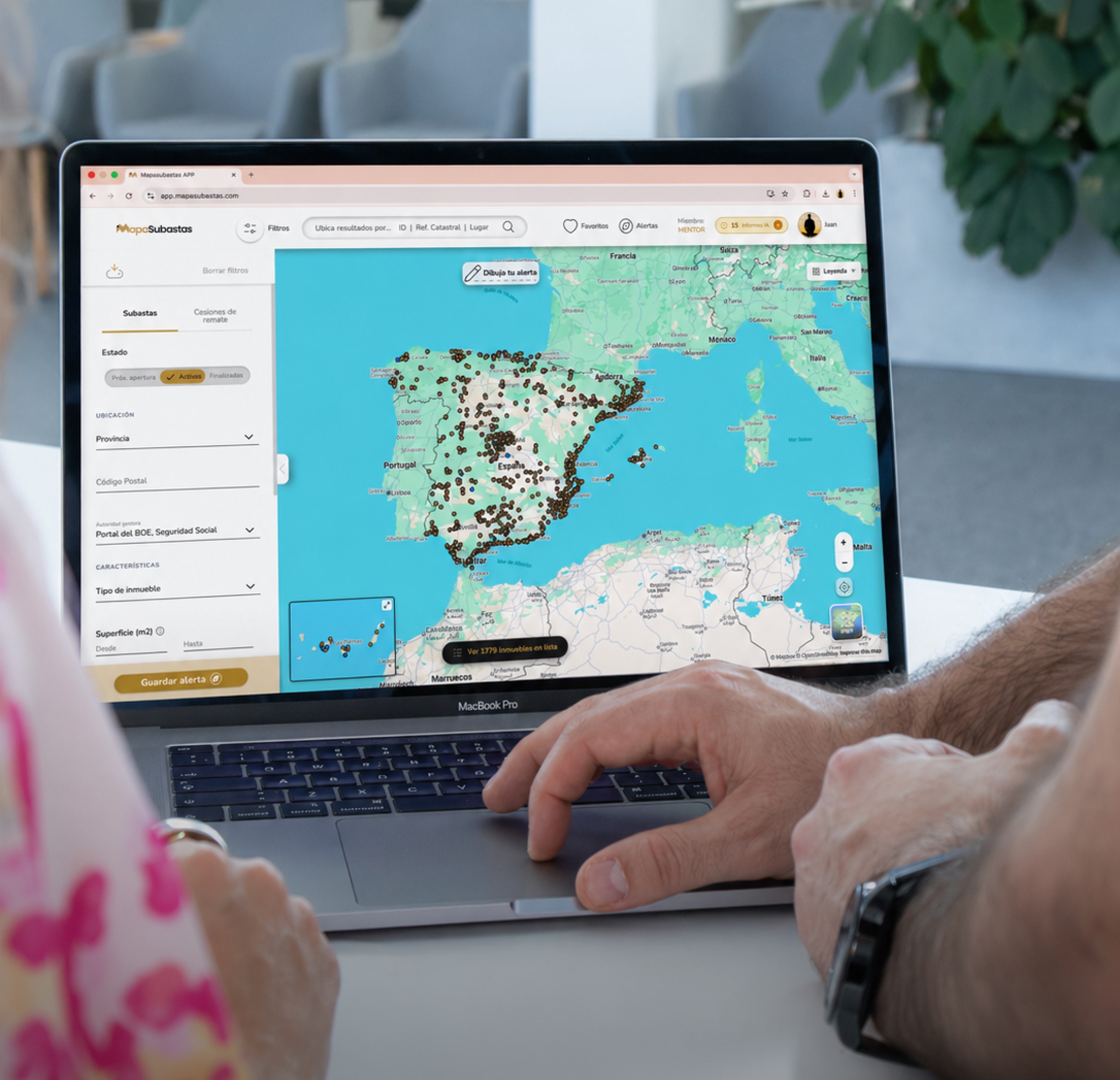
+126k ARR
Projected after designing the new B2B vertical.
+50% revenue
In revenue after rolling out the solutions.
3 weeks
To redesign the new landing page and the users' email chain.
Context
MapaSubastas is an early-stage startup with plenty of potential ahead, built on a bootstrapped strategy, that in a little under two years has already positioned itself as the go-to for searching real-estate auctions in the Spanish market. Even with more and more competition.
The CEO reached out to improve the design and copy of his landing page and the email marketing chain for newly registered users — the goal was to improve conversion. Little by little, as the product settled, the chance came up to reorient the strategy and open a new line of business. The result was far better than expected.
Inside the mind of a professional auction investor
Since one of the goals was to get reviews from at least three subscribers for the landing, I proposed running a usability interview with them to understand first-hand the platform's scope and its user. I interviewed several subscription profiles, from the most basic to the most complete, pulling out insights that would serve all the future work — well beyond this first assignment.
In parallel I kicked off desk research on the niche — the map of players, the types of auction investors, the legal situation in Spain and the latest regulatory changes.
I wanted to go a step further — to speak directly to the kind of user who subscribes after discovering the platform or trying it free for a few days. The channel was the short, simple landing copy, so it had to be designed down to the millimetre.
Luckily, in the Spanish market we have an expert auction investor — Tristán el Subastero — who has earned a strong reputation building his personal brand with social content and online courses. That content is gold — it lets you internalise how a professional auction investor thinks, what they value, how they invest and what they need.
I put a solid synthesis of that content to work in a custom Gemini Gem, trained to act and think according to Tristán's values and strategies.
Branding, copy and structure of the new landing
Even though it wasn't a branding project, the landing was the brand's main shop window. The point was to set MapaSubastas apart from similar — and emerging — platforms with the lever of professionalism. It had to look like a professional SaaS, far from the competitors' UIs — early-2000s styles or the easy-to-spot AI-made aesthetics.
We had to associate the brand with professional investing — anyone who invests regularly in this kind of asset had to see MapaSubastas as their go-to search platform.
Alongside that go-to professionalism, we wanted to keep the initial branding — sober golds and blacks — but elevate it, moving away from the earlier rounded touch (Nunito Sans) toward something more elegant — Manrope for the body, keeping Marcellus for the headings.
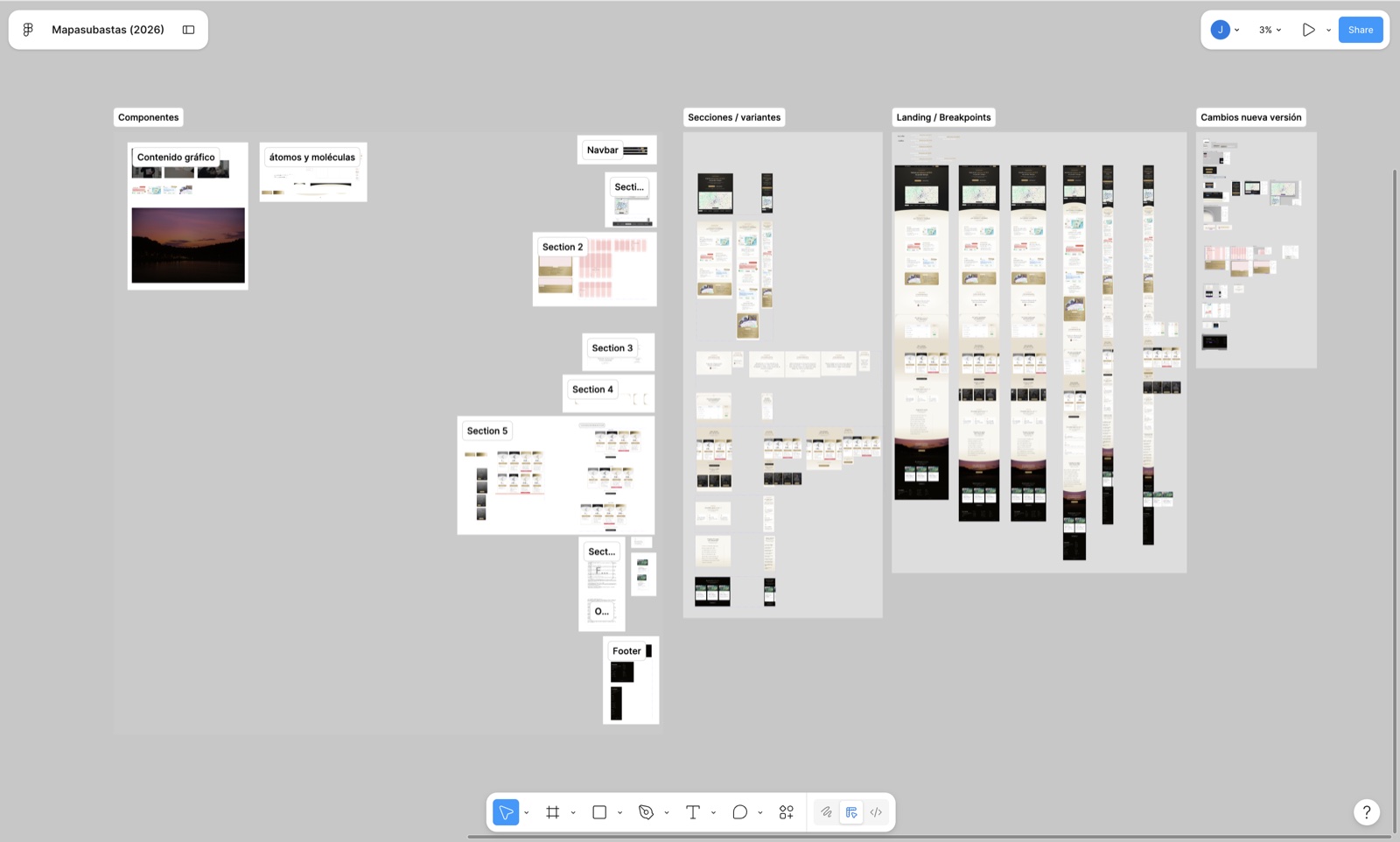
The landing had to show, as concisely and intuitively as possible, the whole user journey — the jobs-to-be-done the platform enables, ordered by the real flow of analysing and buying an auction. From discovery to analysis, through to the team's guidance and extra services (mentoring, physical property visits). All drawn and validated with user insights — what to prioritise and what not. The copy was also adapted for SEO.
Email marketing to close the discovery
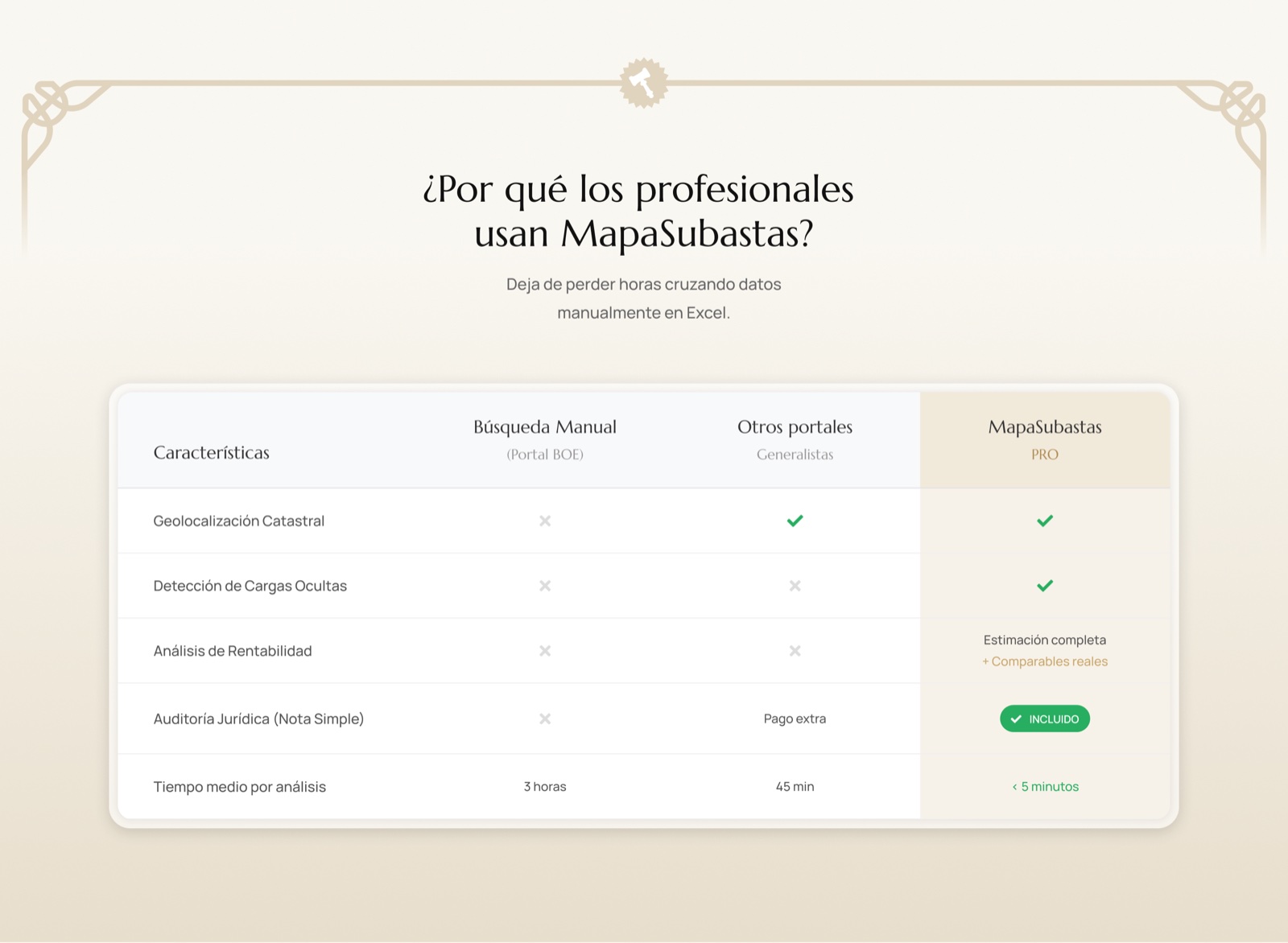
Both in the interview insights and in the benchmark, the AI-powered legal analysis of property liens that had just shipped was, without a doubt, MapaSubastas' big competitive edge.
The decision — steer the user funnel toward that feature, from the email marketing too. The emails played up the new AI capability — the highest-value element and the entry point to conversion. Users could try it for free with gift tokens on sign-up — value delivery started on day one and the reason to subscribe was clear from the start.
The birth of a new vertical
The CEO had just shipped that new feature and I quickly saw it was his unfair advantage over the market — it had to be amplified, even steering the user journey toward the job it enabled.
Shortly after, he proposed I design a new product built on it to maximise its value. The brief was very open — we had to find product-market fit, so the research scope had to be open too.
The priority call was to extend the benchmark to a much broader, more ambitious scope — Spain, the US and the EU, including companies outside the real-estate niche. The mission — map every player, see how that capability was being productised, and where there was room to act.
With a first sweep in deep-research mode with an LLM I pulled enough players to start the second phase. In Chrome, with the Claude extension, I created the /Player shortcut — a prompt designed to capture a company's entire digital footprint — business, product, marketing — from the browser's active tab.
Market analyst, digital product strategist and expert in the real-estate registry information ecosystem. Your job is to produce a complete profile of a player in the registry ecosystem from the current browser tab.
Each player profile was dumped into a Notion database, structured with the finest granularity. That let us filter, sort and, ultimately, run the database through analysis and questions to surface the market gaps we were after.
To close the loop, I did the same with the legal situation of the auctions market.
Looking for our new user
- I interviewed private buyers, especially those who buy a home without an agent's intermediation.
- I interviewed real-estate agents to learn their workflow, what tools they used and how.
- And I interviewed tech profiles from funds and servicers — where our solution clearly fit best.
Designing a product with features that have no direct competition on the market
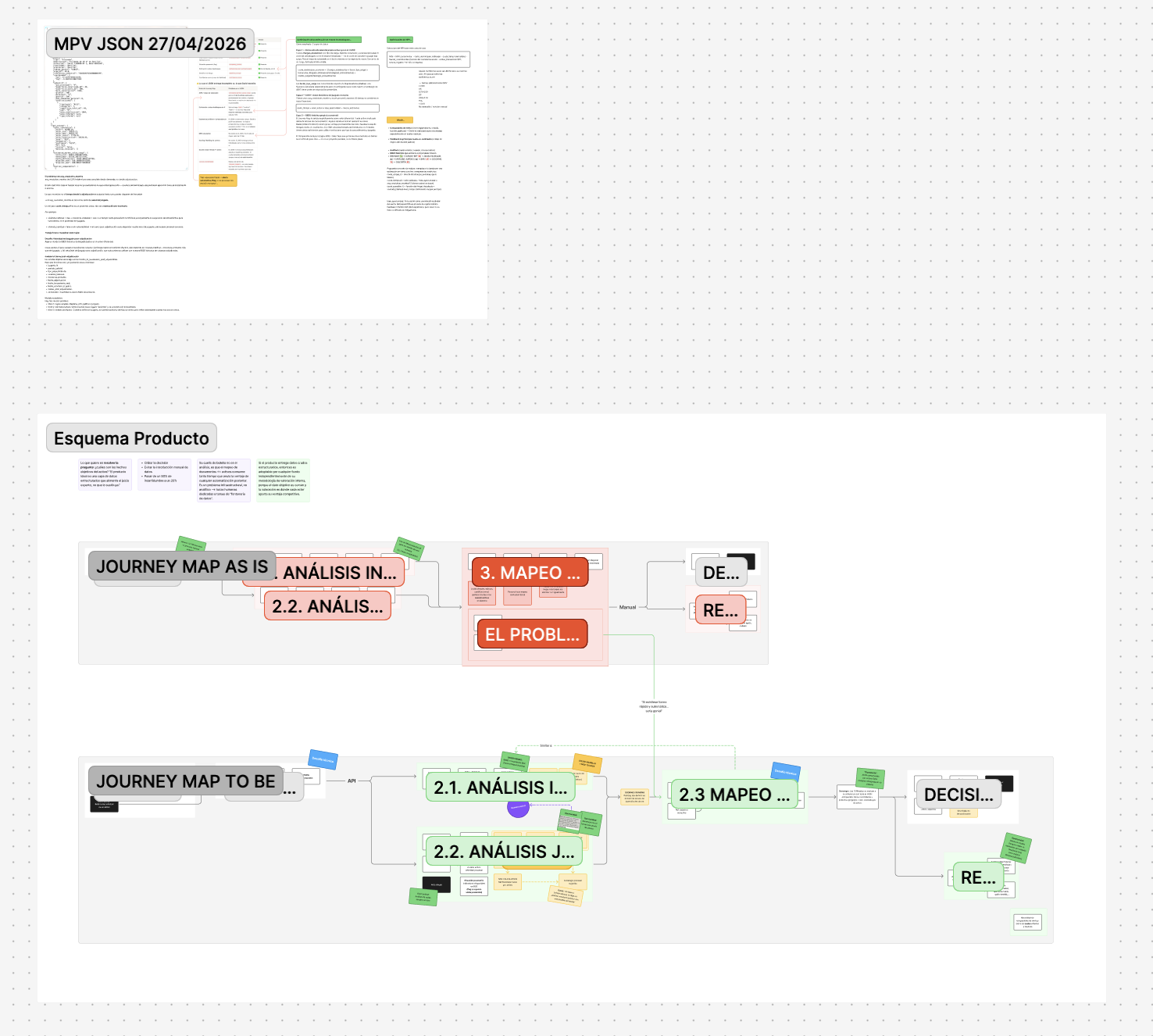
Right away the data no player was capturing started to surface — the opportunities nobody was seizing.
The mix of all the insights — the early-adopter user, their as-is journey versus the to-be journey, the company's current stack and infrastructure — translated into a prioritisation roadmap.
The best solution wasn't a UI. It was a flow centred on automating the delivery of a JSON. I designed its structure and fields, and the MapaSubastas CEO made sure the extraction and assembly of the data was rigorous and accurate.
A first potential client was very interested in the solution and we got to co-create and iterate with them the product that best fit their internal operations.
Thanks to the market research and the UX research I could confirm there was a real data-capture opportunity that nobody was productising or modelling. Delivering that data alongside the rest of the solution gave us a depth and richness no other player offered in our specific niche.
The solution wasn't one more feature, nor an interface — it was more data integrated into a pre-existing flow, encapsulated and productised as the Enterprise solution. From the system to the prototype (the ideation and prioritisation process is private).
We validated it with the first potential client, iterating against their users' real usage — the first proposal was a JSON; it ended up being an enriched Excel. Behind the change was a key insight — for the institutional analyst, browsing time isn't analysis time. Their real working tool is the spreadsheet, where they screen, flag and filter all at once; and every piece of data that arrives already integrated is data nobody has to transcribe by hand.
The result — a new vertical, a high-value subscription tier designed for large institutional investors.
Validation in real use
The client's feedback in real use confirmed the bet — and the most valuable metric wasn't saving over 40% of their previous workflow, but the quality of the decisions they could make and the extra margin to actually execute them.
Projection
The financial model's projection gives the vertical a clear north star:
Designed to contribute ~16% of the company's total revenue over 4 years (~€126k ARR), being the highest-impact driver on its valuation (±€3–8M depending on the model's sensitivity).
Financial model projection